Wednesday, August 23, 2017

Green Space - The Sustainable Souls Project August 2017

Hello and Welcome to The Sustainable Souls Project August Post.

The Sustainable Souls Project is a monthly artist collaboration inspired by sustainability issues, concerns, ideas, and thoughts.  Each month, we will pick a sustainability topic and create awareness through art, using the monthly theme as inspiration.  Projects may include art-journaling, mixed media, assemblage and more. The idea is to create awareness around Sustainability through art, one paint stroke at a time!  We hope to educate, entertain, and share pretty things for both humans and the earth.
August's theme is all about how to use and enhance your natural and artificial habitat for a sustainable life.  Green Space, Natural Ventilation, Trees, Plants, and Air Purification are all connected in the search for a Sustainable Future and represent a fundamental component of any eco-system.

"Green spaces such as parks and sports fields as well as woods and natural meadows, wetlands or other ecosystems, represent a fundamental component of any urban ecosystem. Green urban areas facilitate physical activity and relaxation, and form a refuge from noise. Trees produce oxygen, and help filter out harmful air pollution, including airborne particulate matter. Water spots, from lakes to rivers and fountains, moderate temperatures.
Urban parks and gardens play a critical role in cooling cities, and also provide safe routes for walking and cycling for transport purposes as well as sites for physical activity, social interaction and for recreation. Recent estimates show that physical inactivity, linked to poor walkability and lack of access to recreational areas, accounts for 3.3% of global deaths.
Green spaces also are important to mental health. Having access to green spaces can reduce health inequalities, improve well-being, and aid in treatment of mental illness. Some analysis suggests that physical activity in a natural environment can help remedy mild depression and reduce physiological stress indicators."


Besides the enviromental benefits of green space, it can enhance your mood and happiness levels.  This Time article has more details.  


How can you improve your own personal Greenspace?

1. Take care of your grass. While this may seem like an obvious piece of advice, it’s often overlooked. Taking care of your own front yard is a good first step toward protecting and maintaining your green space. Lawns play a major role in protecting ground water by reducing runoff, thus preventing soil erosion, maintaining soil permeability and conserving water. Lawns also provide an extension of your overall living space, and for many families they become an enjoyable private oasis.

2. Choose flowers and plants that suit your area’s climate. It’s imperative to choose plants and flowers that tolerate your area’s climate. Choosing the correct plants will ensure a beautiful garden year after year and make the job of caring for your plants much easier. Having a beautiful green space has also been known to lower blood pressure, reduce muscle tension, improve attention spans and reduce feelings of fear and aggression.

3. Prune, prune, prune. Pruning is important to maintain your flowers, plants and shrubs year after year, but it also needs to be done correctly. Improper pruning can actually be more harmful than neglecting to prune completely. Proper pruning will produce better blooms, maintain a plant’s desired size, and can even rejuvenate an older shrub. Having well-maintained flowers and shrubs will not only make your green space more attractive, but it will also provide a protective habitat for birds and other creatures that serve to enhance the natural beauty of your outdoor living space.

4. Enrich your soil with a compost pile. Who knew those old coffee grounds, filters and dryer lint could be the golden ticket to creating a beautiful green space? These types of materials, combined with yard clippings, wood chips and leaves, regenerate your soil. The breakdown of these materials creates humus, which is a nutrient-filled material, helping the soil to retain moisture. Compost can also cut down on plant disease and repel pests that are damaging to your yard. Creating a compost pile will not only provide rich nutrients that your soil needs, but it also helps the environment by cutting back on landfill waste, thus extending the life of the landfill.

5. Plant a tree. Planting a tree is one of the most simple and effective activities you can perform to improve your green space. In areas of new construction, many neighborhoods start out virtually treeless. The results include high cooling costs, less oxygen and more pollutants. There are many trees that are inexpensive and fast-growing. In fact, some can grow up to 12’ per year, quickly reversing the effects of new construction. Trees not only help to keep the heat out of the house, but they also cool the outside temperature around your home as well. A study in Huntsville, Ala. showed a 31-degree difference between the shaded and unshaded areas of a parking lot. By using trees to modify temperatures, the amount of fossil fuels used for cooling and heating is reduced.


We asked the Sustainable Souls to create, using this theme as an inspiration point and as a point to share what Green Space means to them.  I think you will be amazed at how each artist interpreted the theme and how they shared their message.
Let's see how 'Green Space' was transformed into art.
(Click names for links to the artist blog post)
Camille McCoy


Melissa Johnson


Tina Walker


Tracy Krueger

In addition this month, we have TWO very special Guest Artists who are Sustainable Souls at heart and fully embrace Green Space and saving our planet!  ♥
First up, please welcome Catherine Scanlon!  Catherine is a wonderful artist and human!  We are so happy and thrilled that she is joining us this month!
Let's see how she was inspired by the theme.....

 Next up is Roxanne Evans Stout.  Roxanne is a fabulous teacher and spirit and we are so excited that she has joined us this month.  


Aren't they simply stunning and fabulous?
I'd like to say a special THANK YOU to each of our Guest Artists.  We appreciate you taking the time to create with us this month and for embracing the importance of Sustainability.

What an incredible collection of art!  I personally love the unique characteristics of each piece and what Green Space means to each person.  

Thank you to each and every artist who took time to create with us this month. 

Do you want to know what Cities are currently doing to create more Urban Green?  Here is a fantastic video by WWF International.


Want to support The Sustainable Souls Project?  Grab our badge, located to the right. --- >
Share it, wear it, display it.  ♥

Wednesday, July 19, 2017

Save the Honey Bees - The Sustainable Souls Project July 2017

Hello and Welcome to The Sustainable Souls Project July Post.

The Sustainable Souls Project is a monthly artist collaboration inspired by sustainability issues, concerns, ideas, and thoughts.  Each month, we will pick a sustainability topic and create awareness through art, using the monthly theme as inspiration.  Projects may include art-journaling, mixed media, assemblage and more. The idea is to create awareness around Sustainability through art, one paint stroke at a time!  We hope to educate, entertain, and share pretty things for both humans and the earth.
July's theme is a very important theme.  Honey Bees are crucial to the environment and aide in the pollination and growth of many of our food products.  

"Honey bees — wild and domestic — perform about 80 percent of all pollination worldwide. A single bee colony can pollinate 300 million flowers each day. Grains are primarily pollinated by the wind, but fruits, nuts and vegetables are pollinated by bees. Seventy out of the top 100 human food crops — which supply about 90 percent of the world’s nutrition — are pollinated by bees.

Biologists have found more than 150 different chemical residues in bee pollen, a deadly “pesticide cocktail” according to University of California apiculturist Eric Mussen. The chemical companies Bayer, Syngenta, BASF, Dow, DuPont and Monsanto shrug their shoulders at the systemic complexity, as if the mystery were too complicated. They advocate no change in pesticide policy. After all, selling poisons to the world’s farmers is profitable.
Furthermore, wild bee habitat shrinks every year as industrial agribusiness converts grasslands and forest into mono-culture farms, which are then contaminated with pesticides. To reverse the world bee decline, we need to fix our dysfunctional and destructive agricultural system."


What can you do to save the Honey Bee?  The Honey Bee Conservancy has several ways to help.


You can reduce or eliminate the amount of pesticides you use.  Explore organic ways to grow plants, such as using compost for healthy soil and controlling pests with homemade remedies and bio-controls such as ladybugs.


We asked the Sustainable Souls to create, using this theme as an inspiration point and as a point to share what Save the Honey Bees means to them.  I think you will be amazed at how each artist interpreted the theme and how they shared their message.
Let's see how 'Save the Honey Bees' was transformed into art.
(Click names for links to the artist blog post)

Camille McCoy


Laura Mooney


Kristie Taylor


Melissa Johnson


Aren't they fabulous?

What an incredible collection of art!  I personally love the unique characteristics of each piece and what Saving the Bees means to each person.
Thank you to each and every artist who took time to create with us this month.  
Want to learn more about bees and what you can do to help save them?  Here's a short video that may answer your questions.
Want to support The Sustainable Souls Project?  Grab our badge, located to the right. --- >
Share it, wear it, display it.  ♥

Wednesday, June 21, 2017

Carbon Footprint - The Sustainable Souls Project June 2017

Hello and Welcome to The Sustainable Souls Project June Post.

The Sustainable Souls Project is a monthly artist collaboration inspired by sustainability issues, concerns, ideas, and thoughts.  Each month, we will pick a sustainability topic and create awareness through art, using the monthly theme as inspiration.  Projects may include art-journaling, mixed media, assemblage and more. The idea is to create awareness around Sustainability through art, one paint stroke at a time!  We hope to educate, entertain, and share pretty things for both humans and the earth.
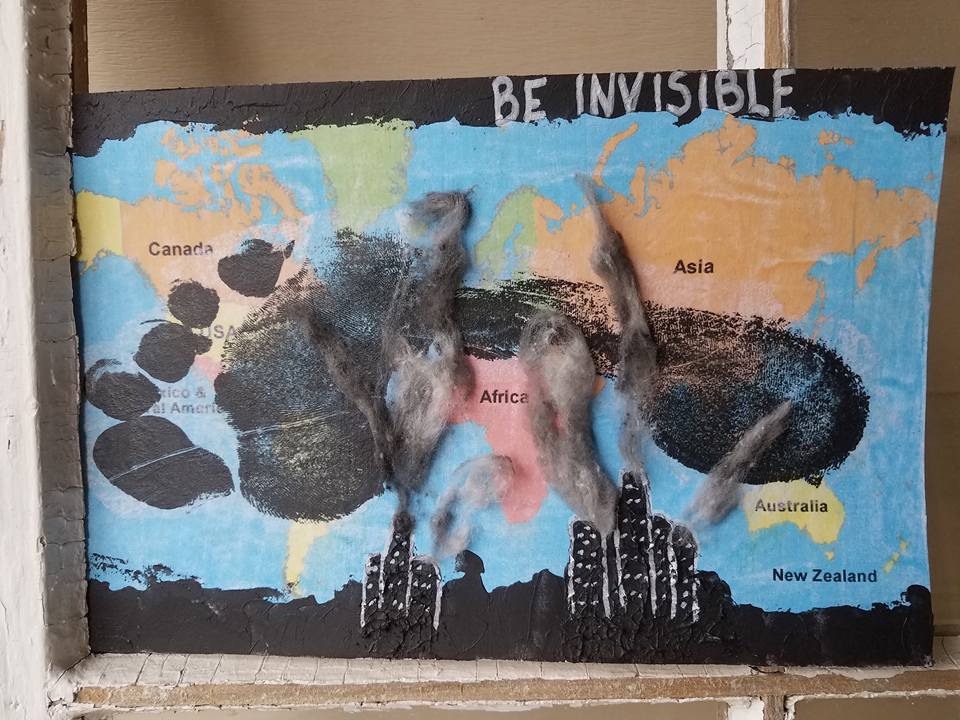
June's theme is an interesting concept, Carbon Footprint.  What is your Carbon Footprint?  Let's start with a definition.


Where did the concept of your Carbon Footprint come from?
The carbon footprint concept took hold at a 1979 U.S. Senate energy committee discussion about the “environmental footprint” of government operations in Yosemite National Park. Tom Rawls, chief environmental officer for Green Mountain, is largely credited with the first quoted use of “carbon footprint” in a Seattle Times article, “Carbon Count: Forests Enlisted in Global Warming War,” published November 18, 2000. From there, the term gained wider use through a 2005 British Petroleum advertising campaign.
While a host of greenhouse gases cause climate change, scientists identify carbon dioxide as the largest source. The U.S. Energy Information Administration found that carbon dioxide emissions from burning fossil fuels accounted for 82 percent of the greenhouse gas released in 2006. Power plants, factories and transportation generate the majority of fossil fuel usage. Personally, the way your travel, the electricity you use, the products you buy and the food you eat all contribute to your carbon emissions.
The main way to reduce your carbon footprint is to decrease your energy consumption. For travel, use public transportation or low-emission vehicles. Insulate your home, use energy-efficient products and reuse or recycle as much as possible. You can also compensate for the effects of your carbon footprint through carbon offsetting. The Nature Conservancy and other organizations provide carbon offset programs that invest donations toward protecting land and planting trees, both proven ways to reduce greenhouse gases.
(source livestrong.com)

On average, U.S. household food consumption emits 8.1 metric tons of CO2e each year. The production of food accounts for 83% of emissions, while its transportation accounts for 11%.
The emissions associated with food production consist mainly of carbon dioxide (CO2), methane (CH4), and nitrous oxide (NO2), which result primarily from agricultural practices.
Meat products have larger carbon footprints per calorie than grain or vegetable products because of the inefficient transformation of plant energy to animal energy.
Ruminant animals such as cattle, sheep, and goats produced 164 million metric tons (mmt) in CO2e of methane in the U.S. in 2014 through enteric fermentation (digestion).
Eating all locally grown food for one year could save the GHG equivalent of driving 1,000 miles, while eating a vegetarian meal one day a week could save the equivalent of driving 1,160 miles.
 A vegetarian diet greatly reduces an individual’s carbon footprint, but switching between different types of meat can have a major impact as well.  For example, replacing all beef consumption with chicken for one year leads to an annual carbon footprint reduction of 882 pounds CO2e.
Organic food typically requires 30-50% less energy during production but requires one-third more hours of human labor compared to typical farming practices, making it more expensive


Iinterested in what your Carbon Footprint is and where you can reduce it?  There are many Carbon Footprint calulators on-line, but here a FREE carbon footprint calculator from nature.org.
We asked the Sustainable Souls to create, using this theme as an inspiration point and as a point to share what Carbon Footprint means to them.  I think you will be amazed at how each artist interpreted the theme and how they shared their message.
Let's see how 'Carbon Footprint' was transformed into art.
(Click names for links to the artist blog post)

Camille McCoy


Michele Kosciolek


In addition this month, we have a very special Guest Artist who is a fellow Sustainable Soul, Deb Weiers.  I fell in love with Deb's 'human' art and thought she would be a perfect guest to join us this month.  We are happy and thrilled that she is joining us this month!


 Aren't they fabulous?
I'd like to say a special THANK YOU to our Guest Artist.  We appreciate you taking the time to create with us this month and for embracing the importance of Sustainability.
What an incredible collection of art!  I personally love the unique characteristics of each piece and what Carbon Footprint means to each person.
Thank you to each and every artist who took time to create with us this month.  

Want to know what you can do to reduce your carbon footprint?  Here's a short video that shows easy ways to make an impact.
Want to support The Sustainable Souls Project?  Grab our badge, located to the right. --- >
Share it, wear it, display it.  ♥


Wednesday, May 24, 2017

Reduce, Reuse, Recycle - The Sustainable Souls Project May 2017

Hello and Welcome to The Sustainable Souls Project May Post.
The Sustainable Souls Project is a monthly artist collaboration inspired by sustainability issues, concerns, ideas, and thoughts.  Each month, we will pick a sustainability topic and create awareness through art, using the monthly theme as inspiration.  Projects may include art-journaling, mixed media, assemblage and more.
The idea is to create awareness around Sustainability through art, one paint stroke at a time! 
We hope to educate, entertain, and share pretty things for both humans and the earth.
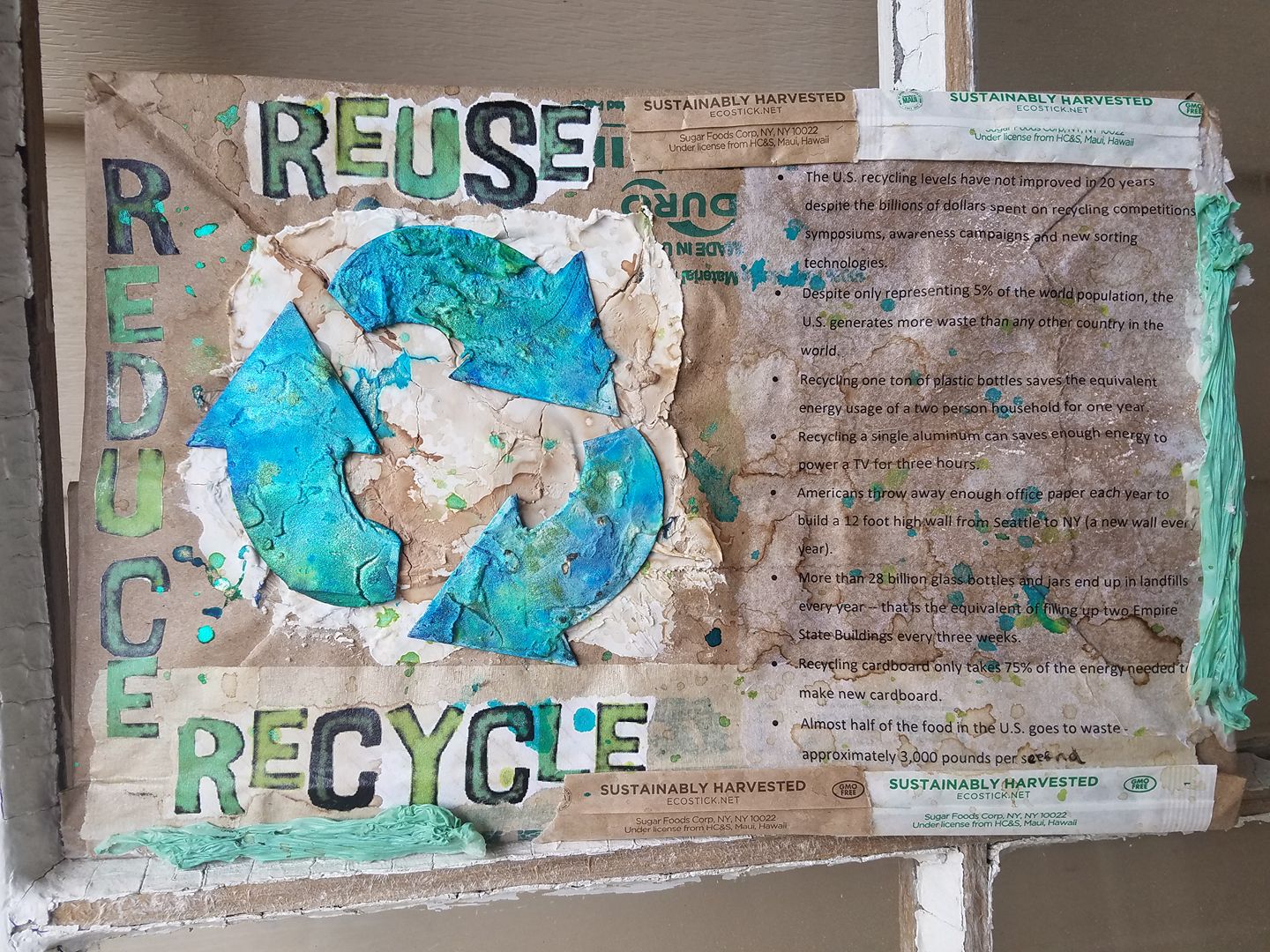
  May's theme is a what people generally think of when you hear Sustainability - REDUCE, REUSE AND RECYCLE.  All three ideas are ways that most humans feel they can personally affect and directly feel the impact of Sustainability.  Waste, and how we choose to handle it, affects our world's environment—that's YOUR environment. The environment is everything around you including the air, water, land, plants, and man-made things.

The most effective way to reduce waste is to not create it in the first place. Making a new product requires a lot of materials and energy - raw materials must be extracted from the earth, and the product must be fabricated then transported to wherever it will be sold. As a result, reduction and reuse are the most effective ways you can save natural resources, protect the environment and save money. (Source EPA)


 You may hear these three terms all the time, but here is a brief explanation of each.

Reduce, reuse and recycle (R3) are the three essential components of environmentally-responsible consumer behavior.

R3 is sometimes called the waste hierarchy. Here's how that hierarchy might apply to computers:
  • The concept behind the first R, reduce, is that you should limit the number of purchases that you make in the first place. So, for example, you might limit your household to a single computer.
  • The concept behind the second R, reuse, is that you should reuse items as much as possible before replacing them. For example, it generally makes more environmental sense to update your computer rather than get rid of it and buy a new one. However, if you do replace your computer, you should ensure that it, or its components, are reused. Many charitable organizations welcome donations of second-hand computers.
  • The concept behind the third R, recycle, is that you should ensure that items or their components are put to some new purpose as much as possible. If your computer is not fit for reuse as is, you can donate it to one of several organizations, such as StRUT (Students Recycling Used Technology), which will refurbish it or recycle its components
(Source What Is)


"While recycling is great in a lot of ways, the ultimate goal is to get people to prevent waste in the first place."

MCKENZIE JONES, "Recycling made easier with new city app", Arizona Daily Sun, February 11, 2016


We asked the Sustainable Souls to create, using this theme as an inspiration point and as a point to share what reduce, reuse, and recycle means to them.  I think you will be amazed at how each artist interpreted the theme and how they shared their message.
Let's see how 'Reduce, Reuse, and Recycle' was transformed into art.

(Click names for links to the artist blog post) 
Camille McCoy


Diana Gabriella


Melissa Johnson


Robyn Crowningshield


Susan Davison


Sydney Drake Hole-Huffaker


Tracy Krueger


In addition this month, we have THREE very special Guest Artists who are Sustainable Souls at heart and fully embraces Reducing, Reuseing, and Recycling.  ♥
First up, please welcome Mary Beth Shaw, owner of StencilGirl Stencils!  We are so happy and thrilled that she is joining us this month!
Let's see how she was inspired by the theme.....


Hmmm, is that baby wipes we see??  She is only giving us a peek at what she created, but we love what we see!  Want to see her entire project, hop on over to her blog and check it out!


Next up is Nathalie Kalbach.  We are so excited that she has joined us again this month.  Her art and journal pages are always 'point on' and really embrace the theme.


Want to know more about her page and what inspired her?  Hop on over to her blog and see what she has to say.  

Last, but not least, our third Guest Artist this month is a beautiful women I met in Iceland, during my trip in February.  I visited her store, Gallery Gimli in Stokkseyri, Iceland.

Please welcome Lara Halldorsdottir.  She makes gorgeous items, recycled from old wool sweaters.  Here's a peek at one of her wool coin purses.  I *may* have bought one of these during my trip.  


Aren't they fabulous?

I'd like to say a special THANK YOU to each of our Guest Artists.  We appreciate you taking the time to create with us this month and for embracing the importance of Sustainability.

What an incredible collection of art!  I personally love the unique characteristics of each piece and what Reduce, Reuse, and Recycle means to each person.  

Thank you to each and every artist who took time to create with us this month.  
Want to know what happens to our recycled products once they leave your bin? We leave you with a video about Reducing, Reusing, and Recycling.


Want to support The Sustainable Souls Project?  Grab our badge, located to the right. --- >
Share it, wear it, display it.  ♥